Quick answer
To clean up wildfire smoke and ash damage, wait until officials say it is safe, wear an N95 respirator and gloves, and never dry-sweep or use a leaf blower. Mist ash lightly, then wipe or HEPA-vacuum. Replace your HVAC filter, and call a pro for heavy soot, odor that will not go away, or ash in the ductwork.
In the Inland Empire, fire season and Santa Ana winds can go hand in hand. When a fire burns in the foothills, strong winds can carry smoke and ash for miles. Your home may still be standing, but it can come back to a fine gray layer on the patio, a film on the windowsills, and a smell that will not leave.
This guide covers how to clean up wildfire ash and smoke safely, what to do with your heating and air system, when it is a job for professionals, and how smoke damage claims work in California.
Why wildfire ash is not just dirt
Ash from a wildfire is not the same as ash from a campfire. When homes, cars, and buildings burn, the ash can carry much more than burned wood. According to the California Department of Public Health (CDPH), fire ash may contain:
- Metals such as lead, cadmium, nickel, and arsenic
- Asbestos from older homes and buildings
- Chemicals from burned plastics, non-stick cookware, and flame retardants
- Caustic materials - some wet ash can even cause chemical burns on skin
Ash can irritate your skin, eyes, nose, and throat, cause coughing, and trigger asthma attacks. The finest particles can be breathed deep into the lungs. That is why the goal is to clean it up without stirring it into the air.
Protect yourself first
- Wear a real respirator. CDPH recommends a close-fitting N95 or P100 respirator. Bandanas, cloth masks, and surgical masks do not block fine particles.
- Cover your skin. Wear gloves, long sleeves, long pants, socks, and shoes. Goggles help too.
- Keep kids out of it. Do not let children play in ash, and wash toys before they use them.
- Wash up after. Wash any skin that touched ash and change out of dirty clothes before going into clean parts of the house.
Cleaning ash outside
- Never use a leaf blower. It throws ash back into the air and into your neighbors' yards.
- Mist hard surfaces lightly with water to keep dust down. A gentle spray is enough - you do not want a muddy runoff.
- Sweep gently, then bag the ash and debris.
- Wipe down outdoor furniture, play equipment, and grills with damp cloths.
Cleaning ash and soot inside
Ash gets in through doors, windows, attic vents, and the HVAC system. Work from the top down and from the outside in, so you are not dropping ash onto surfaces you just cleaned.
- Use a HEPA vacuum only. CDPH advises against shop vacs and regular vacuums without HEPA filters, because they blow fine particles back into the air.
- Do not dry-sweep or dust. Mist or wet-wipe hard surfaces instead, then wet-mop floors.
- Rinse cloths often and change wash water when it gets dirty.
- Wash clothes and bedding that have ash on them. Heavy smoke odor in fabric may need professional cleaning.
- Check the hidden spots: window tracks, door thresholds, ceiling fan blades, and the tops of cabinets.
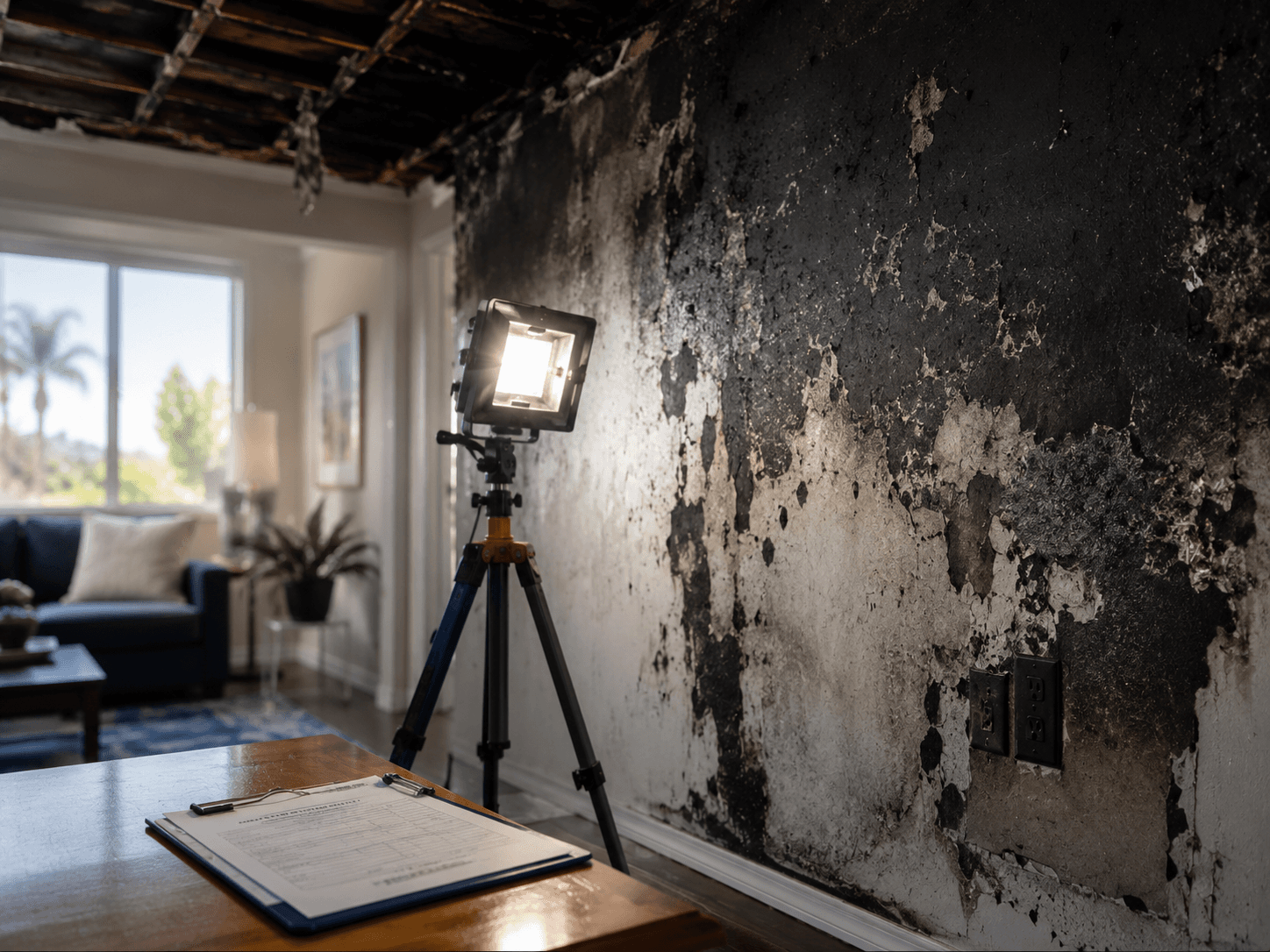
If you see black streaks, greasy film, or webs of soot on walls and ceilings, stop. Wiping soot with water and household cleaners can smear it into paint and texture. That is a sign it is time for professional fire and smoke damage cleaning.
Your heating and air system
Your HVAC system can protect your indoor air during a smoke event, or spread ash all over the house afterward. A few steps help:
- During smoke: the EPA suggests a high-efficiency filter, such as MERV 13, that fits snugly so air does not leak around it. If your system has a fresh air intake, set it to recirculate or close the outdoor damper.
- After the smoke clears: replace the filter. A filter that pulled a lot of smoke and ash out of the air will be loaded and can smell.
- Look at the vents. Gray or black dust around supply registers or return grilles can mean ash or soot got into the system.
- About duct cleaning: the EPA says ducts should only be cleaned as needed, but ducts with heavy dust and debris are one of those times. If ash or soot is inside the ducts, have the system cleaned by a pro before you run it hard.
Smoke odor that will not go away
Smoke odor soaks into porous things - drywall, insulation, carpet, curtains, and upholstery. If the smell is still there after you have cleaned and aired out the house, it is usually coming from something you cannot wipe. Professional odor removal finds the source, cleans or removes it, and uses HEPA air scrubbers to clean the air.
Skip the ozone machines you might see online. The EPA warns that ozone can damage the lungs and that no federal agency has approved ozone generators for use in occupied spaces.
DIY or call a pro?
| What you see | Usually |
|---|---|
| A light layer of ash on patios, cars, and hard surfaces | DIY with an N95, gloves, and a light mist |
| Light dust indoors on hard surfaces | DIY with damp wiping and a HEPA vacuum |
| Black streaks or oily film on walls and ceilings | Call a pro - soot smears easily |
| Ash at the vents or inside the ductwork | Call a pro before running the system |
| Smoke odor that lasts after cleaning and airing out | Call a pro to find and remove the source |
| Your home is close to burned structures | Call a pro, and ask your insurer about testing |
Insurance for smoke damage in California
In March 2025, after the Los Angeles wildfires, the California Department of Insurance (CDI) issued Bulletin 2025-7 on smoke damage claims. It says smoke damage can be covered under policies that insure against "direct physical loss of or damage to" property, but each claim depends on the policy language and the facts.
- A real investigation is expected. CDI says it is not reasonable for an insurer to deny a smoke claim without an appropriate investigation, or to make you pay substantial costs to investigate your own claim.
- Testing: if professional testing is warranted, CDI expects the insurance company to arrange and pay for it.
- Declared emergencies: for claims from a declared state of emergency, your insurer must send you CDI's notice of key California claim laws within 15 days of your claim.
- If you cannot get home: when a civil authority order blocks access to your home during a declared emergency, California requires at least two weeks of additional living expense coverage, with extensions for good cause, subject to your policy.
- Renewals: for one year after a declared wildfire emergency, insurers generally cannot cancel or non-renew homes in ZIP Codes in or next to the fire perimeter based solely on the wildfire.
To support a claim, take photos and video of ash on surfaces, soot on vents and filters, and any stains before you clean. Keep your dirty HVAC filter in a sealed bag, and keep receipts for supplies, cleaning, and any hotel stay. If you hit a wall with your insurer, the CDI consumer hotline is 1-800-927-4357. For more on how claims work, see our guide on homeowners insurance in California.
How we help
First Call Plumbing & Restoration's IICRC-certified techs handle soot and smoke odor removal, contents cleaning and pack-out, and repairs when materials need to be replaced through our reconstruction team. We document what we find and what we do, and we can work with your adjuster. We cannot promise a claim will be approved - that decision is between you and your insurer. If your home was directly hit by fire, see what to do after a house fire.
If ash and smoke got into your home, we can help you clean up safely. We are open 24/7 across the Inland Empire. Call (909) 751-2323 or contact us to schedule an inspection.
Frequently asked questions
Is wildfire ash dangerous to clean up?+
It can be. The California Department of Public Health says ash may contain metals like lead and arsenic, asbestos from older buildings, and caustic materials. Wear an N95 or P100 respirator, gloves, and long sleeves, and never dry-sweep or use a leaf blower.
Can I use my regular vacuum to clean up ash?+
It is not recommended. Shop vacs and vacuums without HEPA filters can blow fine ash particles back into the air. Use a HEPA vacuum, or mist surfaces lightly and wipe them with damp cloths.
Should I change my air filter after a wildfire?+
Yes. A filter that ran during a smoke event can be loaded with smoke and ash. Replace it with a snug-fitting high-efficiency filter such as MERV 13 if your system can handle it. If you see ash at the vents or in the ducts, have the system checked first.
Does homeowners insurance cover smoke damage from a wildfire in California?+
It can. The California Department of Insurance says smoke damage can be covered under policies that insure against direct physical loss of or damage to property, but each claim depends on the policy and the facts. Document the damage before cleaning and ask your insurer about testing.
How do I get rid of wildfire smoke smell in my house?+
Clean hard surfaces, wash fabrics, replace the HVAC filter, and air out the home when outdoor air is clean. If the odor stays, it is usually trapped in drywall, insulation, carpet, or ducts, and professional odor removal is the next step.
This guide is general information, not a quote or professional advice for your specific home or insurance policy. Prices are approximate - we give an up-front quote before any work begins.